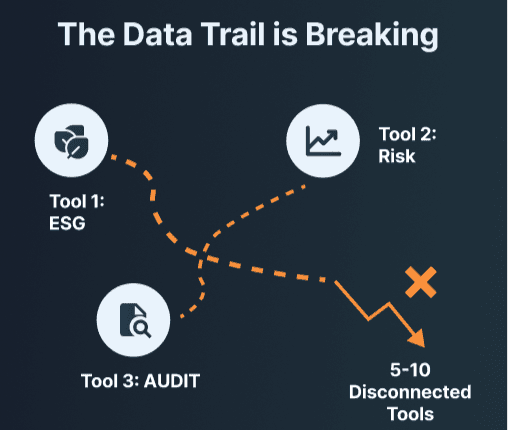
The typical GRC technology stack at a regulated financial institution wasn't designed. It accumulated.
It started with a risk register in Excel. Then a standalone BCM tool was purchased after an audit finding. An ESG reporting platform arrived when the sustainability team needed TCFD disclosures. Internal audit bought their own system. The compliance team has yet another. Each tool does its job adequately in isolation. Together, they create a governance architecture that is structurally incapable of answering the questions regulators are now asking.
Questions like: What is the aggregate risk exposure across your operational resilience, cyber, and third-party risk programmes? How does a breach in one area cascade into others? Can you demonstrate that the data supporting your board risk report is the same data underlying your regulatory submissions?
The honest answer, in most organisations, is no.
The Fragmented GRC Stack
Risk Management
- • Excel risk register
- • Taxonomy: "Critical"
- • Separate data model
BCM / Resilience
- • Standalone BCM tool
- • Taxonomy: "IB"
- • Separate data model
Compliance / Audit
- • Audit management system
- • Taxonomy: Custom
- • Separate data model
Manual reconciliation required
The problem isn't capability — it's architecture
Each tool in the stack was built with its own data model, its own taxonomy, and its own reporting logic. The BCM tool calls a process "critical." The operational resilience tool calls the same process an "important business service." The risk register uses a third label. When a regulator asks for a consolidated view, someone has to manually reconcile these taxonomies — usually in a spreadsheet, usually under time pressure, usually with errors.
Each tool in the stack was built with its own data model, its own taxonomy, and its own reporting logic. The BCM tool calls a process "critical." The operational resilience tool calls the same process an "important business service." The risk register uses a third label. When a regulator asks for a consolidated view, someone has to manually reconcile these taxonomies — usually in a spreadsheet, usually under time pressure, usually with errors.
This isn't a minor inconvenience. It's a structural vulnerability that compounds every reporting cycle. The more frameworks you're subject to — FCA operational resilience, ISO 22301, DORA (for EU-exposed operations), TCFD, CSRD — the more acute the fragmentation becomes. Each framework expects a coherent, auditable data trail. Disconnected tools produce fragmented, manually-reconciled data trails that auditors can unpick.
| Aspect | Fragmented Stack | Unified Architecture |
|---|---|---|
| Data Model | Multiple, inconsistent | Single, canonical |
| Taxonomy | Different per tool | Unified across functions |
| Reporting | Manual reconciliation | Automatic generation |
| Audit Trail | Fragmented, vulnerable | Coherent, auditable |
| Scalability | Degrades with complexity | Scales with regulation |
What "collect once, report everywhere" actually means
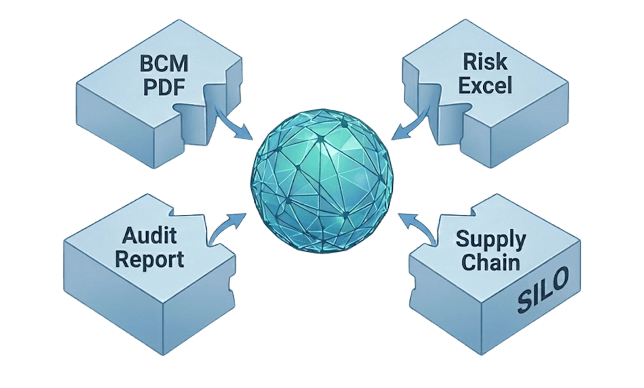
The alternative isn't another integration layer or middleware sitting on top of the existing stack. That approach simply adds another failure point and another vendor to manage. The alternative is an architectural rethink: a single canonical data model where a risk is a risk, a process is a process, and a control is a control — regardless of which framework or function is consuming the data.
In this model, when the BCM team defines a critical process and maps its dependencies, that mapping is immediately available to the operational resilience team, the internal audit function, and the board governance reporting layer. When a control is tested and found deficient, that finding flows through to every framework that depends on it. The board report and the regulatory submission draw from the same source.
Unified GRC Architecture
Single Canonical Data Model
One source of truth • Consistent taxonomy • Unified reporting logic
Automatic flow
This isn't theoretical. It's what well-architected governance infrastructure looks like.
The cost of doing nothing
Organisations that maintain fragmented GRC stacks face three escalating costs:
Direct Cost
1Multiple licences, integrations, and reconciliation processes
Risk Cost
2Data inconsistencies creating audit findings or regulatory actions
Opportunity Cost
3Senior professionals reconciling data rather than analysing it
The firms that solve the architecture problem will find that compliance becomes faster, cheaper, and more reliable.
The firms that don't will find that each new regulation makes the problem exponentially worse.
💡 Key Takeaways
- ✓Fragmentation is structural: Multiple GRC tools with inconsistent taxonomies create governance vulnerabilities, not just inefficiencies.
- ✓Integration isn't enough: Middleware doesn't solve the problem — you need a single canonical data model.
- ✓Costs compound: Direct costs, audit risks, and opportunity costs all escalate with each new regulatory framework.
- ✓Architecture matters: The difference between programmes that scale and those that buckle is foundational design, not feature count.