Most regulated organisations believe they have a reporting problem. They do not. They have an architectural failure.
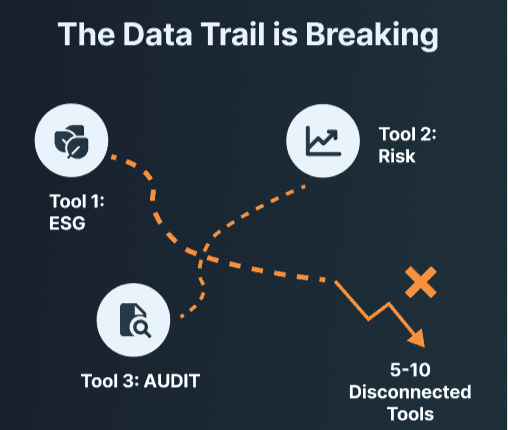
Right now, ESG, risk, and AI governance data is being collected through a fragmented web of spreadsheets, disconnected point solutions, and email threads. The assumption is that if the numbers sit in a cell somewhere, the organisation is compliant.
That assumption is about to be tested. On 2 August 2026, the EU AI Act's main high-risk obligations under Annex III come into force, covering AI systems used in hiring, credit scoring, critical infrastructure, and essential services. Penalties reach up to 15 million EUR or 3% of global turnover for many infringements and up to 35 million EUR or 7% of global annual turnover for the most serious prohibited practices. When a regulator asks for the conformity assessment, the risk management documentation, and the complete data lineage behind an AI system's classification, the manual data trail will not hold up.
And it is not just AI governance. In the UK, FCA Sustainability Disclosure Requirements take effect from January 2027. For organisations still in scope of the CSRD following the EU Omnibus simplification, those with over 1,000 employees and 450 million EUR turnover, limited assurance standards are due by mid-2027. The direction of travel is unmistakable: non-financial data is being held to financial-grade standards of evidence.
The Rigour Gap: Why "Non-Financial" Is No Longer "Non-Critical"
The risk nobody is pricing in is the absence of data lineage. If an organisation cannot prove who entered a data point, who validated it, and how it moved from a source system to a final report with a single click, that data is not audit-grade.
Most assembled platforms on the market are black boxes. Data goes in. A report comes out. But when an auditor or regulator asks for the immutable trail behind that report, the timestamps, the approvals, and the separation of duties, it simply does not exist. The platform was built to produce documents, not to withstand scrutiny.
This matters now because regulatory expectations are converging. The EU AI Act requires documented risk management systems, data governance records, and conformity assessments for high-risk AI systems. CSRD assurance for those still in scope demands verifiable data lineage from source to disclosure. FCA SDR requires evidenced product-level sustainability claims. Each of these regulations assumes an infrastructure that most organisations have not built.
Three Questions That Reveal Whether Data Is Audit-Ready
1. Is the data model unified? Are ESG, risk, and AI governance running on a single engine with shared controls and a common audit trail, or are they bolted-on acquisitions requiring manual reconciliation at reporting time?
2. Is every entry immutable? Is each data point timestamped, attributed to a named user, and locked from the moment of entry, or can it be edited in a spreadsheet without a log?
Just as "shadow IT" created unmanaged technology risk a decade ago,
unregistered ESG and AI data silos are growing every month. Every
department collecting sustainability or risk data outside the system of
record is a gap waiting for the auditor to find.
From Data Cleaning to Strategic Advisory
For advisors and consulting practices, this architectural gap has a direct commercial consequence. Time spent cleaning inconsistent client data is time not spent delivering high-value strategy. Worse, recommendations built on unverifiable data lack the evidentiary backbone to survive audit scrutiny and when an assurer pushes back, it reflects on the advisor's practice, not just the client's.
For enterprises, the consequence is simpler: every month without a unified governance infrastructure is another month of data being created without lineage, without attribution, and without the controls that an auditor or regulator will expect to see.
Building the Infrastructure That Holds Up
SustainGRC was purpose-built to close this gap. It is an AI-native governance and sustainability intelligence platform that treats non-financial data with the same rigour as financial data, built by practitioners who have sat on both sides of the audit table across 20 years of Big Four assurance.
Thirty production-ready modules across ESG reporting, enterprise risk management, internal audit, AI governance, board governance, and supply chain compliance, unified in a single data model. Collect once, validate once, report everywhere. Every data point timestamped, attributed, and immutable. A patent-pending AI Validation Engine. Financial-grade data controls from source to report.
The organisations that will be ready for what is coming in August 2026 and January 2027 are the ones building governance infrastructure now, not the ones still assembling spreadsheets.
Download: The Governance Infrastructure Your Clients Are Missing
Our partner programme overview sets out how advisory practices can use SustainGRC as the technology backbone for governance and sustainability engagements replacing fragmented data with a single, audit-ready platform. It includes a comparison of assembled platforms versus unified infrastructure, the partnership model, and how to start a conversation.
Your data is not your audit trail.
On 2 August 2026, the EU AI Act's main high-risk obligations take effect. For organisations deploying or providing high-risk AI, regulators will expect robust risk management, data governance, technical documentation, logging, human oversight, and traceability, with fines reaching up to 15 million or 3% of global turnover for many infringements and up to 35 million or 7% for the most serious prohibited practices.
When a regulator asks for the evidence behind an AI system's risk classification, the timestamps, approvals, segregation of duties, and audit trail many organisations still will not have it. The core point is fair as a business argument, because the Act does require logging and traceability for high-risk systems, even if it does not use your exact "data lineage behind risk classification" phrasing.
This is not a tooling gap. It is an architectural failure.
At SustainGRC, we built a governance infrastructure where every data point is timestamped, attributed, and immutable from the moment of entry. Thirty modules. One data model. Built by practitioners with decades of Big Four assurance experience.
The organisations that will be ready for August 2026 are building their governance infrastructure now.
Full article and partner programme overview below.