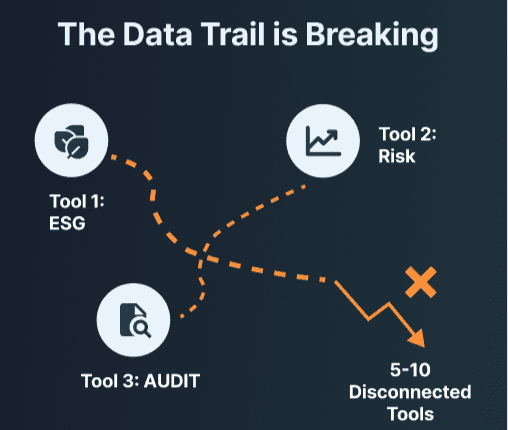
Four functions, four records of the same institution
The bank is regulated across prudential, data protection and operational resilience regimes, and audited on all three. Its second and third lines are well staffed and well run. The difficulty is not capability.- Internal audit works in a dedicated audit tool
- Data protection impact assessments and records of processing sit in spreadsheets kept by the privacy team
- Business continuity analysis and continuity planning live in a third set of files owned by resilience
- Enterprise risk holds the register
Regulation is not the burden. Fragmentation is.What the bank went to market for was not a replacement audit tool. It was a single environment in which risks, controls, findings and assessments are the same objects, referenced by every function that needs them.
What shaped the evaluation
A traceable line from a control test back to the obligation it satisfies — and four requirements that ruled most of the market out before the demonstrations began.Coverage of risk, audit, privacy and continuity with no integration work between them.
On-premise deployment, including the AI layer — data does not leave the bank.
Role separation across preparers, testers and reviewers, in states that survive inspection.
A commercial model that does not penalise adoption across the first line.
Sequence
SEQUENCE Start with one workflow. Add the next without rebuilding anything.The spreadsheet workflows, migrated as they are
Impact assessments, records of processing and business impact analysis move across largely unchanged. The incumbent audit tool is untouched. Migrating a familiar process before improving it keeps the change cost with the technology rather than the team.
Control testing and internal audit
Brought across once the environment is stable and the standing data, frameworks and access structure have settled under real use.
Integrated risk reporting
Last, because it depends on the taxonomy the earlier phases put in place. Reporting built before the taxonomy is reporting that gets rebuilt.
What a single data model changes
Connected modules exchange data. A single data model has nothing to exchange. A control tested by internal audit is the same record the privacy assessment relies on and the same one the continuity plan assumes.AI inside the perimeter
A bank that cannot send data offshore usually cannot use AI-assisted governance. SustainGRC deploys its AI layer inside the institution's own environment, on the same on-premise footprint as the platform. Within that boundary the AI:- Drafts — a risk description, a first-pass assessment, a mapping between an obligation and an existing control
- Confirms — the responsible officer confirms or rejects it
- Records — the platform records the suggestion, the decision and the person who made it, so the trail explains not only what was concluded but how